أسباب زيادة معدل استخراج الدقيق في الولايات المتحدة
KANSAS CITY, MISSOURI, US – The flour extraction rate in US flour mills has increased steadily over the past 80 years or so, from 71.6%% to 77.5%, according to statistics from the US Department of Commerce. The trend begs the question: What is the reason for this improvement?
Data shown in Table 1 (right) present yield or extraction data based on the wheat ground for flour. Yield is reported for 98% of the milling industry with milling capacity of 400 cwts/day (approximately 25 tonnes/day of wheat). In the United States, flour mill yield often is expressed as the number of bushels of wheat required to produce a hundredweight (100 pounds) of flour.
Those working in the mill on a daily operational basis more often focus on the flour yield or extraction based on the wheat to first break or B1. First break wheat has been cleaned and tempered as needed to produce product with desired properties. In the process of cleaning, the removal of non-wheat material and wheat not suited for milling represents a reduced quantity of wheat to the mill.
The addition of moisture in tempering increases the mass of wheat moving to B1. Both the cleaning and tempering are dynamic processes that vary in magnitude due ideally limited to properties of wheat purchased but realistically impacted by equipment and operational variability. Measuring performance based on the tempered wheat to B1 allows the operator to focus on the mill, assuming proper operation of cleaning and tempering units has taken place, thus providing a uniform mix or grist of clean tempered wheat.
For the milling company executives to measure performance of its assets and raw materials from an overall perspective, it is appropriate to measure performance based on the amount of wheat purchased.
Some factors that may have resulted in steadily increasing flour yield since 1940 include changes in agronomic practices, changes in the milling process over time and the market. As one might imagine, each of the factors have components or issues that potentially have both positive and negative impacts on flour yield.
Wheat variety improvements and selection along with use of fertilizers, pesticides, fungicides, and herbicides have improved wheat production quality.
Improvements in harvest technologies, moving from sheath and thrashing to modern-day combining, also have improved the quality of wheat delivered to the market.
Improvements in wheat testing and grading, transportation, and storage and handling management, including temperature monitoring and pest control practices, have contributed to increased yields based on dirty wheat delivered to the mill.
Equipment for cleaning, tempering, and milling undoubtedly have led to increased ability to extract the 85% endosperm available more precisely from the wheat kernel. Even at today’s flour yield, a significant proportion of the wheat endosperm leaves the milling operation as a feed byproduct. Nearly 25% of mill byproduct may be measured as starch, which is 78% or more of the wheat endosperm, suggesting the potential for additional yield increases. Hopefully, millers and equipment manufacturers address that challenge as we seek to feed the world’s increasing population.
The Economic Research Service branch of the US Department of Agriculture collects current and historical wheat data in Wheat Data: Yearbook Tables. Wheat and flour price relationships in the Kansas City market are provided based on No. 1 hard red winter, 13% protein and cost of 2.28 bushels based on a 73% extraction rate. Wheat and flour price relationships in the Minneapolis market are provided based on No. 1 dark northern spring, 14% protein and the cost of 2.28 bushels based on a 73% extraction rate.
Use of 2.28 bushels per hundredweight of flour production observed in the 1960s significantly overestimates the cost of raw materials when compared to the current yield level of approximately 2.15 bushels/cwt. Imagine mills operating at 2.28 bushels/cwt today may be looking for a new miller.
As previously indicated, first-break wheat has been cleaned and tempered as needed to produce flour with desired properties. Wheat flour ash (non-combustible mineral remaining after a flour sample is burned) content is a controversial wheat flour property. Ash itself may not impact baking performance but the presence of ash in other wheat flour components and compounds, including perhaps enzymes involved in transport during kernel development in and around the Aleurone layer, may impact performance.
Outside the United States there is less focus on ash content with greater focus on color and other functional properties. Countries or markets utilizing ash consider it a measure of milling performance reflecting the miller’s ability to separate bran, germ and endosperm.
Wheat milling flows have become shorter and more heavily loaded with aggressive grinding and reduction approaches. While this may increase flour yield, it also may contribute to increased flour ash content. Others suggest that to increase wheat yield per unit of land that additional and smaller kernels are being bred into wheat varieties, resulting in increased wheat ash.
The point is that increased flour yield for a given mill usually results in higher ash flour given the current processing technology. The relationship is more of a sigmoid shaped curve low in ash content (0.25% to 0.35%) in the very beginning and gently increasing as endosperm is isolated and sharply increases as more bran than endosperm is available for recovery.
The ash content of pure endosperm varies due to variety, class and production environment variations falling in a range of 0.18% to 0.22%, while the ash content of bran is in the range of 6.5% to 7.5%. Keep in mind that milling is not a surgical separation, therefore even the earliest lowest ash flour produced has a higher ash content than pure endosperm.
As mentioned earlier, some suggest that additional and smaller kernels are being bred into wheat varieties to increase wheat yield per unit of land in wheat production. It is well documented that smaller wheat kernels produce higher ash flour. US Wheat Associates data suggest hard red spring wheat is slightly higher in ash content compared to hard red winter, and more importantly the five-year average of each wheat class dating back to 2000 encompassing 1996 production is similar or slightly decreasing in wheat kernel ash.
Wheat kernel ash data from the Wheat Quality Council showing various standard control varieties grown across various regions of the United States in 2010 and a single control wheat variety grown across varying but similar hard red winter wheat growing regions do not appear to demonstrate increasing wheat kernel ash content.
Two of the nine samples reported in 2020 had extremely low ash contents (1.1% and 1.3%), suggesting a potential error in analysis, data reporting or unusual growing conditions (perhaps greater rainfall). These modified data suggest wheat kernel ash of hard wheat for flour production lies between 1.34% to 1.78%.
When the public or nutritionists suggest millers determine the properties of wheat flour with respect to nutrition or color, it shows a lack of understanding in the supply chain. Millers work to provide flour meeting the baking industry and/or consumer specifications or expectations. They do not set the specifications or standards. Annually, at least, and sometimes more often, the miller must explain the impact of crop harvest quality, wheat availability and mill capability in achieving customer specifications and expectations. Economic and technical considerations are balanced in the baking industry just as they are in the milling world. In turn, the baking industry is driven by the demands of the final consumer of their product.
In the 1940s, short patent, long patent, and straight grade flour were reported to have ash ranges from 0.30 to 0.35%, 0.35 to 0.40% and 0.41 to 0.48%, respectively. In the 1980s, bread flour ash was reported to be 0.42 to 0.44% (19% m.b.). The ranges were also confirmed in various research papers of the time reporting the use of commerically produced bread flour.
Today, the reported bread flour ash content is 0.50% to 0.55% (14% m.b.). The allowable increase in ash content is most likely the result of economic pressure to reduce flour cost by the bakery customer. Increased flour yield lowers the cost of wheat needed to produce a unit of flour. Pressure to reduce ingredient cost at the bakery or for customers generally justifies a technical sensory test between the current standard ash content flour and a slightly increased ash content of perhaps 0.02% in the flour.
Given the small incremental change in flour ash content, the ability to identify a statistically significant negative processing or finished product performance is minimized and the higher ash flour is accepted, becoming the new standard. Having been part of such evaluations in cereal and bakery facilities, it is possible to confirm that such evaluations become cyclic in nature and over time — perhaps several decades — the standard has appreciably increased.
Any expectation of returning to a past set point in ash content is eschewed due to cost as the lower ash flour required would likely come at an increased cost. Marketing and market research would have to spend a significant amount of money in plant and product consumer testing to determine if the increased cost would provide improvement in trial and repeat sales, thus increasing brand profitability. This would be a very difficult justification.
As flour yield will increase, ash content of straight grade flour is likely to increase until technological advances improve the degree of separation in the milling process. Economics will demand it, and it will happen if bakers and consumers find the technical consequences acceptable. The good news for the baking industry and consumers is that whatever ash content is required can be supplied, at a price. The good news for the milling industry is we can produce low or high ash flour products to meet specifically justified wide ranging bakery and consumer demands.
https://www.world-grain.com/articles/16519-reasons-for-us-flour-extraction-rate-increase
أسباب زيادة معدل استخراج الدقيق في الولايات المتحدة
كانساس سيتي، ميزوري، الولايات المتحدة – شهد معدل استخلاص الدقيق في مطاحن الدقيق الأمريكية زيادة مطردة على مدى الثمانين عامًا الماضية تقريبًا، حيث ارتفع من 71.6% إلى 77.5%، وفقًا لإحصائيات وزارة التجارة الأمريكية. يثير هذا الاتجاه التساؤل: ما هو السبب وراء هذا التحسن؟
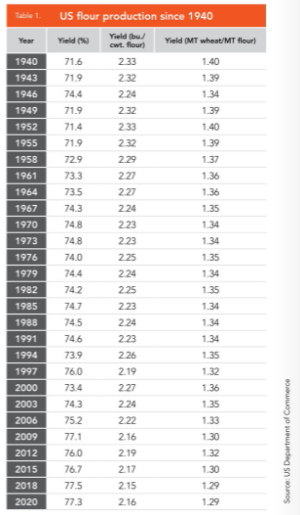
تُظهر البيانات الواردة في الجدول 1 معدل العائد أو الاستخلاص بناءً على كمية القمح المطحون لإنتاج الدقيق. يغطي التقرير 98% من صناعة الطحن بقدرة إنتاجية تبلغ 400 وزن مائة يوميًا (حوالي 25 طنًا من القمح يوميًا). في الولايات المتحدة، يُعبَّر عن إنتاجية المطاحن غالبًا بعدد بوشل القمح المطلوب لإنتاج 100 رطل من الدقيق.
يُركز العاملون في المطاحن على أساس يومي بشكل أكبر على معدل العائد أو الاستخلاص بناءً على القمح المستخدم في الكسر الأول (B1). يتم تنظيف وتكييف القمح المستخدم في الكسر الأول حسب الحاجة لإنتاج دقيق بمواصفات مرغوبة. وفي عملية التنظيف، يتم إزالة المواد غير القمحية والقمح غير المناسب للطحن، مما يقلل من كمية القمح المخصصة للطحن.
تُضيف عملية التكييف الرطوبة، مما يزيد من كتلة القمح الموجهة إلى الكسر الأول. كل من عمليات التنظيف والتكييف هي عمليات ديناميكية تختلف في الحجم، وتتأثر بخصائص القمح المشتراه، وكذلك بتقلبات المعدات وعمليات التشغيل. قياس الأداء بناءً على القمح المكيف الموجه إلى الكسر الأول يسمح للمشغل بالتركيز على أداء المطحنة، بافتراض تشغيل وحدات التنظيف والتكييف بشكل صحيح، مما يوفر خليطًا موحدًا من القمح النظيف والمكيف.
قياس الأداء وتحسين معدل الاستخلاص
بالنسبة لمديري شركات الطحن، فإن قياس الأداء من منظور شامل يتطلب النظر إلى كمية القمح المشتراة. هناك عوامل متعددة قد ساهمت في زيادة معدل استخلاص الدقيق بشكل مطرد منذ الأربعينيات من القرن الماضي، منها:
1. تحسين الممارسات الزراعية:
تحسين أصناف القمح واختيارها.
استخدام الأسمدة والمبيدات الحشرية والفطرية والأعشاب.
2. تطور تقنيات الحصاد:
الانتقال من الحصاد التقليدي إلى الحصاد الآلي الحديث.
3. تحسين تقنيات اختبار القمح وتخزينه:
تحسين إدارة النقل والتخزين، بما في ذلك مراقبة درجة الحرارة ومكافحة الآفات.
4. تطوير معدات الطحن:
ساعدت معدات التنظيف والتكييف والطحن الحديثة على زيادة القدرة على استخلاص السويداء بنسبة تصل إلى 85% من نواة القمح بدقة أعلى.
أهمية محتوى الرماد في الدقيق
يُعتبر محتوى الرماد (المواد المعدنية غير القابلة للاحتراق المتبقية بعد حرق عينة الدقيق) من الخصائص المثيرة للجدل في الدقيق. لا يؤثر الرماد نفسه بالضرورة على أداء الخبز، لكن وجوده في مكونات أخرى من الدقيق قد يؤثر على الأداء.
خارج الولايات المتحدة، يتم التركيز بشكل أقل على محتوى الرماد وأكثر على اللون والخصائص الوظيفية الأخرى. تُعتبر بعض الأسواق الرماد مقياسًا لأداء الطحن يعكس قدرة الطحان على فصل النخالة والبذرة عن السويداء.
مع مرور الوقت، أصبحت عمليات الطحن أكثر قصرًا وأثقل تحميلًا مع استخدام أساليب طحن أكثر عدوانية. قد يؤدي ذلك إلى زيادة العائد، ولكنه أيضًا يساهم في زيادة محتوى الرماد.
العلاقة بين العائد ومحتوى الرماد
الزيادة في العائد غالبًا ما تؤدي إلى ارتفاع محتوى الرماد في الدقيق نظرًا للتكنولوجيا الحالية. يختلف محتوى الرماد في السويداء النقي وفقًا لتنوع القمح وبيئة الإنتاج، ويتراوح بين 0.18% و0.22%، بينما يتراوح محتوى الرماد في النخالة بين 6.5% و7.5%.
تأثير التغيرات في خصائص القمح
تشير البيانات إلى أن أصناف القمح ذات الحبوب الصغيرة، التي تم تطويرها لزيادة العائد، قد تسهم في زيادة محتوى الرماد. ومع ذلك، تشير بيانات مجلس جودة القمح إلى أن محتوى الرماد في حبوب القمح لم يظهر زيادة ملحوظة على مدى العقود الأخيرة.
توازن العوامل الاقتصادية والتقنية
يواجه الطحانون ضغوطًا لتقليل تكاليف الإنتاج مع الحفاظ على تلبية متطلبات السوق والمستهلكين. يتعين عليهم تحقيق توازن بين الاعتبارات الاقتصادية والتقنية لتقديم منتجات تلبي التوقعات.
في الأربعينيات، تراوح محتوى الرماد في أنواع الدقيق بين 0.30% و0.48% حسب نوع الدقيق. في الثمانينيات، ارتفع محتوى الرماد في دقيق الخبز إلى 0.42% - 0.44%. حاليًا، يصل محتوى الرماد في دقيق الخبز إلى 0.50% - 0.55%.
توضح هذه الزيادة أن الضغوط الاقتصادية أدت إلى قبول محتوى رماد أعلى لتقليل تكاليف الإنتاج. من المتوقع أن يستمر هذا الاتجاه حتى تتطور تقنيات جديدة لتحسين فصل السويداء عن النخالة.
اليوم، يتراوح المحتوى المعلن للرماد في دقيق الخبز بين 0.50% و0.55% (على أساس رطوبة 14%). الزيادة المسموح بها في محتوى الرماد من المرجح أن تكون نتيجة الضغط الاقتصادي لتقليل تكلفة الدقيق من قبل العملاء في المخابز. زيادة إنتاجية الدقيق تقلل من تكلفة القمح اللازمة لإنتاج وحدة من الدقيق. عادةً ما يبرر الضغط لتقليل تكلفة المكونات في المخابز أو للعملاء إجراء اختبار تقني حسي بين دقيق بمحتوى رماد قياسي حالي ودقيق بمحتوى رماد أعلى قليلاً ربما بنسبة 0.02%.
نظرًا لصغر التغير التدريجي في محتوى رماد الدقيق، يتم تقليل القدرة على تحديد أي تأثير سلبي ذو دلالة إحصائية على الأداء أثناء المعالجة أو على المنتج النهائي، ويتم قبول الدقيق ذي محتوى الرماد الأعلى ليصبح المعيار الجديد. وبناءً على مشاركتي في مثل هذه التقييمات في منشآت الحبوب والمخابز، يمكن تأكيد أن هذه التقييمات تصبح دورية بطبيعتها ومع مرور الوقت — ربما عدة عقود — يزيد المعيار بشكل ملحوظ.
أي توقع بالعودة إلى نقطة ضبط سابقة لمحتوى الرماد يتم استبعاده بسبب التكلفة، حيث إن الدقيق ذو محتوى الرماد المنخفض المطلوب سيأتي على الأرجح بتكلفة أعلى. سيتعين على التسويق وأبحاث السوق إنفاق مبلغ كبير على اختبارات المستهلكين للنباتات والمنتجات لتحديد ما إذا كانت التكلفة المتزايدة ستوفر تحسنًا في المبيعات التجريبية والمكررة، مما يزيد من ربحية العلامة التجارية. سيكون من الصعب جدًا تبرير ذلك.
مع زيادة إنتاجية الدقيق، من المرجح أن يزداد محتوى الرماد في الدقيق ذو الدرجة المباشرة حتى تحقق التطورات التكنولوجية تحسينًا في درجة الفصل في عملية الطحن. ستفرض الاقتصاديات ذلك، وسيحدث إذا وجد الخبازون والمستهلكون العواقب التقنية مقبولة. الخبر السار لصناعة الخبز والمستهلكين هو أنه يمكن توفير أي محتوى رماد مطلوب، ولكن بتكلفة. والخبر السار لصناعة الطحن هو أننا نستطيع إنتاج منتجات دقيق ذات محتوى رماد منخفض أو مرتفع لتلبية الطلبات المختلفة المبررة بشكل خاص من قبل المخابز والمستهلكين.